
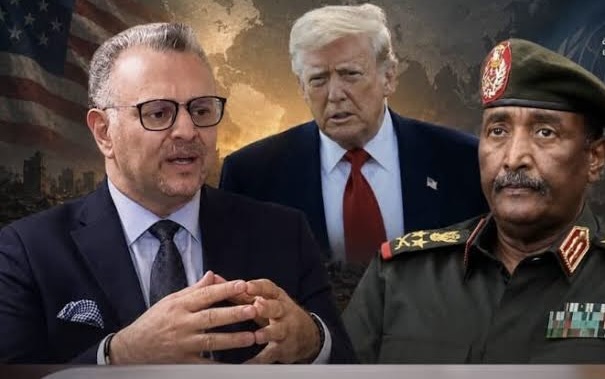
The U.S. administration is becoming increasingly frustrated with the Sudanese Armed Forces (SAF) over their reluctance to endorse a proposed ceasefire, according to a report published by Africa Intelligence, as diplomatic efforts to end Sudan’s more than three-year conflict continue to stall.
The report reveals that the issue was at the center of a meeting held in Cairo on June 21 between U.S. Special Envoy for Africa Massad Boulos and Sudanese Sovereign Council member Lt. Gen. Shams al-Din Kabbashi, one of General Abdel Fattah al-Burhan’s closest military aides.
According to the report, Boulos, who initiated the meeting, warned Sudanese officials that President Donald Trump’s administration was rapidly losing patience with Port Sudan’s leadership because of the lack of progress toward a ceasefire. He also reportedly cautioned that additional punitive measures were being considered, a warning that was followed days later by U.S. Treasury sanctions imposed on companies linked to Sudan’s military establishment, including Target Multiactivities Co. (TMAC), SBL Energy, and Ports Engineering Co.
Nearly a month after the 21 June meeting in Cairo between the US’s special envoy for Africa, Massad Boulos, and Shams al-Din Kabbashi, one of army chief Abdel Fattah al-Burhan’s right-hand men, the first details are only now beginning to emerge. The US envoy, who took the initiative for the meeting, warned that the patience of President Donald Trump’s administration with Port Sudan was running out, mentioning forthcoming sanctions – which later became clear on 26 June, in the light of measures announced by the US Treasury. General Kabbashi had tried to use the meeting to slip in a personal request on behalf of the head of the Sudanese Armed Forces (SAF): the lifting of sanctions targeting Burhan and imposed in January 2025. The request was made however without it becoming a precondition for any diplomatic progress in the conflict that has pitted him for more than three years against General Mohamed Hamdan Dagalo, known as “Hemeti”, the leader of the Rapid Support Forces (RSF). The meeting between the two men, intended to revive negotiations that have been stalled for months, was not enough to break the deadlock. While the SAF chief’s office says it has not approved the latest version of the ceasefire presented by Boulos, it nevertheless sent technical implementation proposals on 25 June which, in reality, amount to a set of conditions laid down by Port Sudan. The following day, the Office of Foreign Assets Control (OFAC), a body under the supervision of the Treasury Department, announced new sanctions on Target Multiactivities Co (TMAC), SBL Energyand Ports Engineering Co, companies linked to Port Sudan’s government, notably the military conglomerate Defence Industries System (DIS). A recycled text Beyond those few messages, the Cairo meeting did not significantly shift the lines. The US text – which provides for a 90-day humanitarian truce, the demilitarisation of controlled areas followed by a nine-month civilian transition – recycles the Quartet proposal that Burhan had already rejected in September 2025, citing the Emirati presence in this mediation group comprised of Washington, Riyadh, Cairo and Abu Dhabi. The only notable change in the new text is the priority now given to North Darfur and North Kordofan, against the backdrop of growing threats to the capital of the latter, El Obeid, which is now under siege. The standstill is still rooted in a fundamental disagreement. For Port Sudan, the truce proposed by Washington would give the RSF an opportunity to rearm. The red line remains unchanged: the SAF want, first and foremost, Hemeti’s forces to be confined to military camps, with no legal recognition of their control over the territories conquered since the war began in April 2023. At the same time, Kabbashi has demanded recognition of General Burhan’s sovereignty and the designation of the RSF as a terrorist organisation, repeating word for word the plan presented by Prime Minister Kamil Idris to the United Nations in September 2025. Rumours circulated on social media and in the press that the warring parties had reached common ground on a humanitarian ceasefire project and a roadmap for peace but these were swiftly dismissed by Boulos. Trump’s adviser on Africa denied on the X platform any imminent truce, saying that several substantial points remained unresolved, or even rejected, and that any formal agreement would be officially announced. Shams al-Din Kabbashi, the SAF’s singular voice Within the military hierarchy, Kabbashi stands out. He is seen, both by Sudan’s political class and by foreign chancelleries, as one of the few figures in Port Sudan open to dialogue. His stance contrasts with the line taken by the SAF chief, who remains convinced that military victory is still within reach – even if that requires multiplying diplomatic manoeuvres. Several of his own allies reproach him for his silence on a Sudanese ceasefire, even though he did not hesitate to publicly praise the agreement between Washington and Tehran reached in June. Formerly the SAF’s number two, Kabbashi was demoted in April to the post of assistant to the commander-in-chief in charge of construction and strategic planning, after the deputy command post he had held since the start of the war was done away with. General Yasser al-Atta (AI, 10/07/26) was preferred for the post of chief of staff, even though Kabbashi had initially seemed to be the likely candidate