

Policy Assessment by Zaelnoon Suliman – African Affairs Unit – Progress Center for Policies – London
Introduction
The announcement by the majority of political Islamist currents in Sudan expressing support for the Iranian regime in the ongoing war against what they describe as Israeli aggression coincided with statements from some jihadist factions declaring their readiness to participate in the fighting. This development comes at a particularly complex moment for Sudan, as the country continues to endure a prolonged internal war. These positions raise questions about their potential impact on the balance of power within Sudan’s internal conflict and on Sudan’s regional standing at a time when the Middle East is witnessing a broad military escalation.
The significance of these statements lies in the fact that they reflect an attempt by Sudanese Islamist forces to reposition themselves politically within a regional environment marked by increasing polarization between an axis led by Iran and another led by the United States and Israel. These movements appear to be seeking to restore their political role after their influence declined following the fall of the regime of Omar al-Bashir, taking advantage of the ongoing internal conflict and the need of some components of the military authority to mobilize supportive social and political constituencies.
The statements issued by Sudanese Islamist factions therefore appear primarily as an attempt at political repositioning within a tense regional context. At the same time, they carry potential implications for power balances within Sudan and for the military government’s relations with its regional and international environment. The actual impact of these statements will depend largely on whether the military establishment adopts this rhetoric or instead seeks to confine it to the realm of political mobilization without turning it into official state policy.
Key Developments
- Al-Naji Abdullah, known as the “Commander of the Mujahideen,” one of the leaders of brigades allied with the Sudanese Armed Forces, declared during a Ramadan jihadist iftar gathering their readiness to fight alongside Iran in the event of a ground intervention by the United States and Israel. He called for opening the borders for that purpose. He also expressed support for Iran in the ongoing war, stating that their rifles and artillery were ready and that they possess advanced generations of drones. He stressed that they do not recognize the United Nations, the Security Council, or regional organizations. He added that Sudan is a country of jihad and struggle and would not allow the return of the Forces of Freedom and Change (FFC), changes to educational curricula, or attacks on the Islamic approach.
- The Sudanese Islamic Movement, led by Ali Karti, stated that what the region is witnessing is part of a broader project aimed at weakening the Islamic world and fragmenting its unity. In a statement, it condemned all forms of aggression against Arab and Islamic countries, violations of sovereignty, and attacks on civilians. At the same time, it stressed that its priority is defending Sudan and its people against current challenges. The movement emphasized that its official positions are issued only by its leadership and that statements to the contrary do not represent it—an implicit reference to the statements by the “Commander of the Mujahideen” supporting Iran.
- In contrast, the commander-in-chief of the Sudanese Armed Forces, General Abdel Fattah al-Burhan, threatened decisive action against groups that declared readiness to defend Iran in its war against Gulf states, stressing that the armed forces stand against such groups and against anyone who supports or encourages aggression against the Arab Gulf countries.
- The official spokesperson for the Sudanese army denied that the jihadist groups expressing support for Iran or readiness to participate in the war belong to the armed forces, confirming that legal measures will be taken against them.
- At the diplomatic level, Sudan’s Ministry of Foreign Affairs maintained its critical stance toward the United Arab Emirates, despite condemning the attack, by excluding the UAE from the solidarity statement issued for the other Gulf states. This partial approach reflects an attempt to exploit the incident to reaffirm the ongoing hostility between the two sides. It can also be interpreted in the context of convergence with the statement issued by the Islamic Movement—the political incubator—which condemned the American and Israeli attacks on Iran while avoiding reference to the targeting of Gulf states.
Analysis
Islamist movements of various currents interpret the military developments in the region within the framework of a broader struggle over Islamic identity and a perceived threat to the survival of their political systems. This is not only due to the potential loss of military and technical support but also because the Islamic Republic of Iran represents, both morally and materially, the contemporary model that inspired their own early experience in governance.
At the same time, the internal reality in Sudan—marked by fragmentation and the severe humanitarian and political crisis caused by the ongoing war—along with developments in the war involving Iran, has compelled Islamist factions supporting the army to avoid direct involvement in the conflict. They appear aware that any explicit alignment with Iran would impose military and diplomatic costs far beyond the country’s capabilities.
Moreover, adopting a position of neutrality would require the presence of a legitimate government enjoying broad public consensus capable of protecting national interests. Such legitimacy has been lacking since these Islamist currents were removed from power by a popular uprising, a development that later contributed to the coup against the transitional government and the outbreak of the current war.
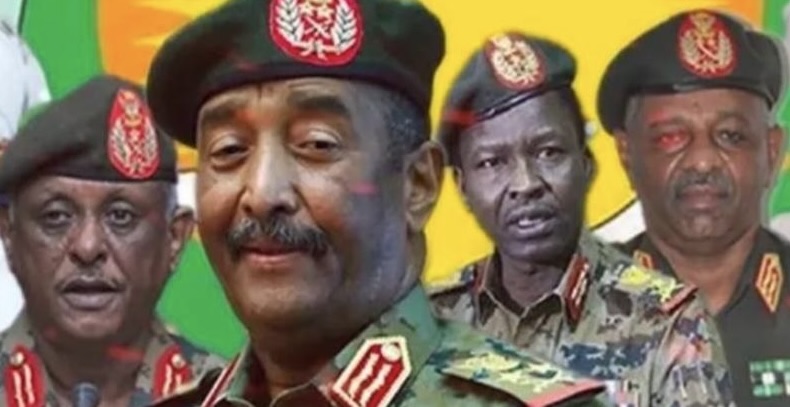
The differing positions within Sudan’s wartime camp regarding the conflict between Iran on one side and the United States and Israel on the other reveal a state of confusion and division within the forces supporting the continuation of the war and their political base in Port Sudan.
This divergence essentially reflects competing tendencies within the same camp. One faction leans toward supporting Iran on religious grounds and because of its role as a major ally and supporter in Sudan’s current war. Another faction prefers alignment with the Gulf axis based on regional calculations and political interests related to Sudan’s external relations. Meanwhile, a third tendency seeks to adopt a middle position that condemns both sides while avoiding clear alignment with either—an approach associated with partners in power, including the army leadership, Islamist groups, and armed movements.
Conversely, analysts and experts estimate that the Sudanese government led by General Abdel Fattah al-Burhan could be among the biggest losers if Iran were to lose the war, given the loss of a significant strategic ally and supporter. Some analysts expect that such an outcome could push Sudan back toward negotiations through the initiative of the Quad Mechanism. If the Iranian regime survives and endures, however, the situation in Sudan may not change significantly, with the likely continuation of the war, the rejection of the Quad initiative, and the transformation of Sudan into a theater of proxy conflict.
Conclusions and Assessments
The war in Sudan has become heavily influenced by Gulf dynamics and regional rivalries. The Iran–Israel–United States conflict could also affect the external logistical support received by the parties to the Sudanese conflict, potentially giving one side a logistical advantage or complicating the ability of both sides to secure such support.
Regional and international attention to efforts aimed at ending the war in Sudan may decline as the Iranian-American-Israeli conflict dominates the regional agenda, particularly given the direct involvement of three members of the Quad Mechanism initiative—the United Arab Emirates, Saudi Arabia, and the United States—in the ongoing confrontation.
The differing positions regarding the war between Iran and the United States and Israel reveal fractures within the coalition supporting the continuation of the war in Sudan. They point to the absence of a unified stance and the existence of multiple centers of influence and decision-making within the pro-war camp, reflecting a decline in political cohesion among its components.
At the same time, these developments—according to the saying “every cloud has a silver lining”—may open the door to regional consensus around a political solution in Sudan. Such an opportunity could be seized by Sudanese political and military forces to end the war and preserve the country’s unity.