Sudanese voices
by: Haider Al-Mokashfi
Women and Children of Darfur: The First Victims of a War That Knows No Mercy.
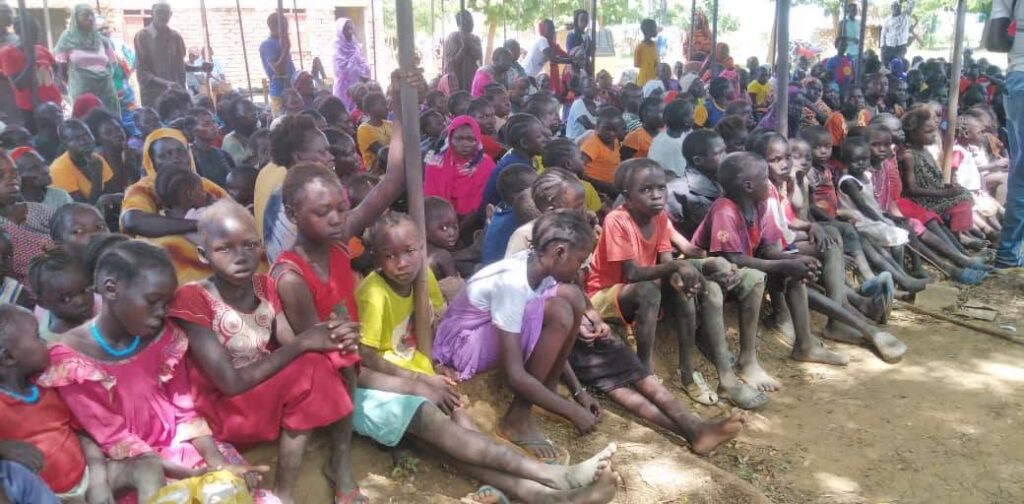
“Mother, will we return to our home?” a little girl asked, her age above seven years old, who directed it to her mother as she sat beside a tattered tent in one of the displacement camps in Darfur. The mother found no answer; she simply gazed at the distant horizon, having left behind a burned village, a husband lost in the inferno of war, and memories that now have no place except in the heart. During her journey of displacement, the mother carried her infant in one arm, while holding the hand of the daughter who asked the question with the other, as hunger weighed down her exhausted body. She was not searching for a new homeland, only for a sip of water, a handful of flour, or a single night that would pass without the sound of gunfire and fear. This woman is not an exceptional case; she is an image that encapsulates the story of hundreds of thousands of Darfuri women whose lives have turned into an unbroken chain of loss, displacement,
hunger, and fear one of the worst humanitarian catastrophes the world is witnessing.
In Darfur, women appear to bear the greatest burden not because they stand on the front lines of battle, but because they bear its consequences in full. She is the mother who has lost her children, the wife whose breadwinner has disappeared, the displaced woman who has left her home, the woman confronting hunger, illness, fear, and violence all at once. War in Darfur does not kill only with bullets; it also kills through hunger, through displacement, through the absence of medicine, and through an international silence that has lasted far longer than it should. And if men are the fuel of the battles, women have become the fuel of the human tragedy consuming the region day after day.
Today, displacement camps are filled with thousands of women who have lost nearly everything: their homes, their farms, their sources of livelihood, their husbands and children, and even their sense of safety. Many have become the sole breadwinners for shattered families, struggling to secure a livelihood in an environment that fails to provide even the minimum requirements for life. Reports from the United Nations and humanitarian organizations confirm that women and children make up the overwhelming majority of the displaced in Darfur, while humanitarian needs continue to grow faster than organizations’ capacity to respond, due to funding shortfalls and ongoing security and logistical restrictions that hinder the delivery of aid.
Hunger Is Not the Only Face of the Tragedy
The Darfuri woman faces another war, no less brutal, embodied in the risks of gender-based violence and the violations that recur with every wave of displacement on the roads leading to water sources, while searching for firewood or food, and in areas where the law is absent and armed force reigns instead. While statements of condemnation continue to pile up, real protection remains absent, justice remains deferred, and the numbers of victims silently grow.
Women’s suffering does not end with displacement and hunger, as human rights reports repeatedly warn of the escalating risks of gender-based violence, including assaults and violations that women face while displaced, while searching for water and firewood, or while attempting to reach markets and public facilities. With judicial and security institutions weakened, ideologized, and politicized, many victims find themselves unable to report these crimes or obtain redress, turning the crime itself into a new burden added to an already long chain of suffering.
Because war does not content itself with stealing the present, it has stolen the future as well. Thousands of girls have dropped out of school; pregnant women give birth in tents lacking even the most basic medical care; and mothers watch their children waste away from malnutrition and lack of medicine. The collapse of the health system in Darfur is no longer merely a service crisis; it has become a slow sentence of death for women and children. The few health centers still operating suffer from acute shortages of medicine and staff, while disease and malnutrition spread at a pace that warns of an even greater catastrophe.
If the war has exposed the fragility of the state, it has also exposed the scale of international failure. Despite repeated warnings from the United Nations and relief agencies, the humanitarian response remains far below the scale of the disaster, even as financial contributions decline and the gap in needs widens. Meanwhile, the warring parties remain preoccupied with calculations of control and influence, leaving civilians, women and children foremost among them to pay the full price. The longer the conflict drags on, the more widows there are, the wider the circle of orphanhood grows, and the greater the number of women who carry on their shoulders the responsibility of entire families, with no income, no protection, and no horizon.