
BLUE NILE STATE Sudan
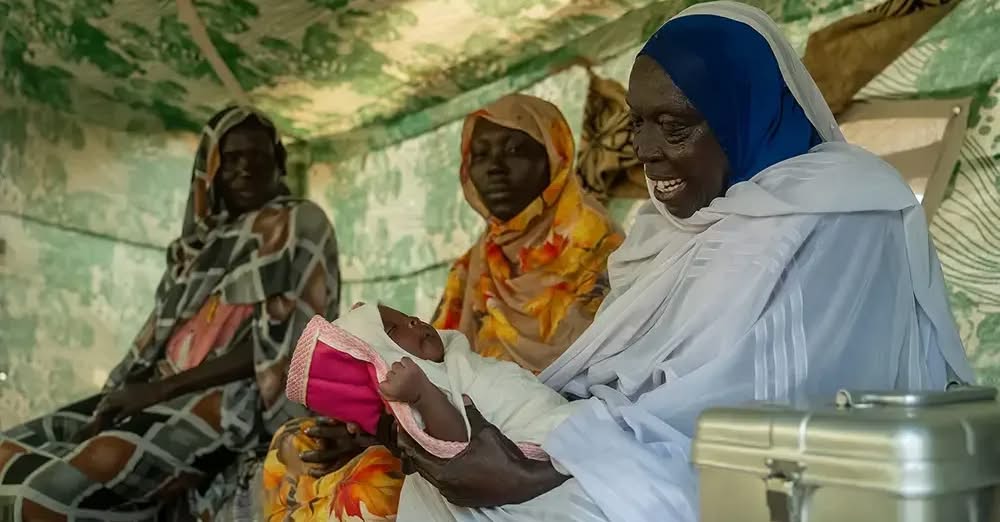
“Some women gave birth on the road,” said Sa’aida, a midwife from Bot, in Sudan’s Blue Nile State. “We provided emergency assistance and whatever support was needed. If there hadn’t been trained midwives, the situation would have been extremely difficult.”
From January to May 2026, intense fighting displaced tens of thousands of people in Blue Nile State, mostly women and children. As many shelter in crowded displacement camps, ongoing violence, damaged infrastructure and frequent flooding are making access to essential healthcare all too often impossible.
“There could have been deaths from severe bleeding,” Sa’aida told UNFPA, the United Nations Population Fund, which is the UN’s sexual and reproductive health agency. “The mother could have lost her life, and the baby too.”
Sa’aida herself was forced to flee her home in 2024, and is now working at a UNFPA-supported mobile health clinic set up in Al Karama 3 displacement camp in the state capital Ad-Damazin. She is one of 15 midwives deployed and equipped as part of a UNFPA initiative to rapidly train and recruit these crucial health workers in the communities where they are needed most.
“The mother could have lost her life, and the baby too” – Sa’aida
“Without her, I would have suffered greatly,” said Somaya, who Sa’adia assisted in the camp. “We have no money, and we do not know where to go or how to access health services here. Without her help, I would not have been able to reach the hospital.”
“Having Sa’adia in the camp has given us a sense of security.”
Safya was also deployed by UNFPA to Al Karama, and keeps a register of all pregnant women and where they live. “If a woman doesn’t come to see me, I go to her wherever she is to check on her and find out why she didn’t come,” she said.
Across Sudan, many health facilities remain non-functional, leaving displaced pregnant women without safe and consistent access to maternity care. UNFPA teams are running mobile clinics and over safe spaces across the country, but many have been forced to close due to sweeping funding cuts.
“Most women give birth here in the camp, but some cases need to be referred to the hospital, especially older mothers and women who have had many previous births,” explained Safya. “I don’t take risks with their lives. Whenever I identify a complicated case, I arrange for an immediate referral.”
“She truly saved my life, and I am deeply grateful for the care and support she provided” – Al Raddyia
Al Radyyia, a mother of 11 children, sought antenatal care from Safya when she arrived at the camp heavily pregnant. “I went into labour and experienced contractions for an entire day. When the pain intensified, I called her and she came immediately. She asked how many children I had delivered before. I told her this is my eleventh.”
Safya recognized that Al Radyyia’s labour was high-risk and referred her to Ad-Damazin maternity hospital, where she delivered safely. “Even afterwards, Safya visited me every two days to check on us,” she told UNFPA.
Both mother and baby are healthy and doing well, but without skilled care, things could have taken a very different turn. “She truly saved my life, and I am deeply grateful for the care and support she provided,” said Al Raddyia.
Midwives can deliver almost all essential sexual and reproductive health services – from promoting family planning to identifying and referring obstetric emergencies, supporting survivors of gender-based violence and contributing to disease surveillance and health education.
“Pregnant women come to me regularly to ask about their pregnancies and what they should do to stay healthy,” said Safya. “I follow each woman from the third month of pregnancy until she delivers safely.”
And investing in midwifery is known to be one of the most cost-effective, successful and sustainable ways to improve maternal and newborn health and survival.
“Today, our work goes beyond caring for pregnant women,” continued Safya. “We also provide essential medicines and postnatal care for breastfeeding mothers. The rainy season is one of our biggest challenges. It makes it very difficult to move around within the camp and even harder to reach hospitals when women need emergency care.”
During the first three weeks of their deployment, UNFPA-supported midwives assisted 140 safe deliveries and provided follow-up care to more than 700 pregnant women. With support from the Government of Norway, UNFPA is currently training 30 more midwives in White Nile State and another 30 in North Kordofan State for deployment to respond to the growing maternal and reproductive health needs in these crisis-affected areas.
UNFPA is also providing referrals to the maternity hospital in Ad-Damazin for Caesarean sections, as well as cash and voucher assistance to support other complicated deliveries. An isolation room is also available for pregnant women with Hepatitis E to ensure safe, specialized care amid deteriorating sanitation conditions in the camp.
In 2026, UNFPA is appealing for US $129.2 million to respond to critical sexual and reproductive health and gender-based violence response needs in Sudan. As of August, only around one third of this funding has been received.