
Policy Analysis by Zaelnoon Suliman | African Affairs Unit, Progress Center for Policies – London
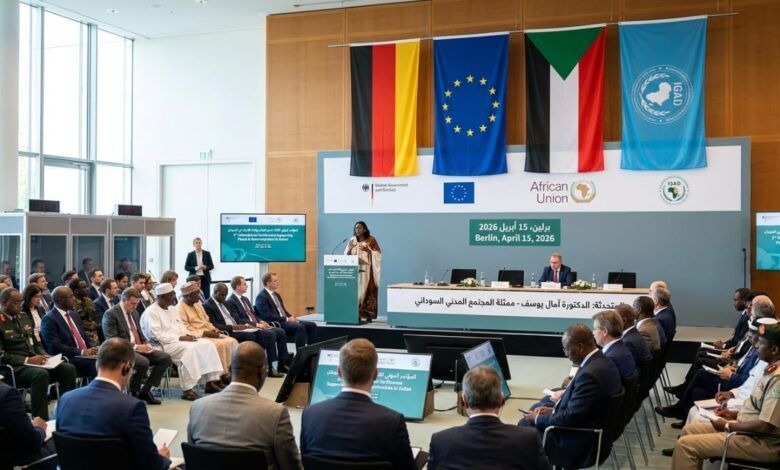
Preface: The Berlin Conference on Sudan, convening on 15 April, coincides with the third anniversary of the outbreak of the war — at a complex international and regional moment in which relative attention to the Sudanese file is waning in favour of more pressing crises, particularly in the Gulf and the Levant. The conference comes at German initiative, in partnership with France, the United Kingdom, and the United States, alongside the European Union and the African Union, in an attempt to reinvigorate the international track toward one of the world’s most complex humanitarian crises. Yet this international mobilisation runs up against a fundamental question: does the conference represent a genuine turning point toward ending the war, or does it fall into a pattern of managing the crisis without the capacity to resolve it?
The Facts
A broad spectrum of international and regional actors are participating in the Berlin Conference, including the foreign ministers of major European states, representatives from the United States, Saudi Arabia, Egypt, the UAE, Turkey, and Qatar, alongside the United Nations, major humanitarian organisations, and Sudanese political and civil forces.
The Sudanese government in Khartoum, however, refused to participate, arguing that the conference reflects a “guardianship approach” toward national decision-making, and signalled a potential review of its relations with the organising states. Political forces aligned with the government also boycotted the conference in their official capacity, while other civil forces participated — most notably the Democratic Civil Alliance “Sumoud” led by Abdullah Hamdok, alongside the “Tasis” coalition linked to the Rapid Support Forces and the Sudan People’s Liberation Movement.
At the international level, Germany affirmed that the conference’s objective is to bring together the parties most influential in the conflict — including the regional powers backing each side — to coordinate efforts toward ending the war. Washington, meanwhile, indicated it is working on a UN mechanism to monitor a ceasefire, as a preliminary step toward a broader political process.
Analysis
First: The Legitimacy Gap Between the Domestic and the International
The Berlin Conference suffers from a structural problem regarding its internal legitimacy, given the absence and outright rejection of the Sudanese government. This absence limits the capacity of any outcomes to translate into implementable decisions and reinforces the narrative that frames the international track as an attempt to impose externally conceived solutions. On the other side, the Quint mechanism sought to address this gap by organising preparatory meetings in Addis Ababa, with the aim of forging a unified civil position that would lend the conference a degree of Sudanese ownership. However, this track remains of limited impact in the face of sharp divisions among civil forces and a proliferation of competing political platforms.
Second: Between Humanitarian Relief and the Complexities of a Political Solution
The conference faces a dual challenge: responding urgently to the humanitarian crisis while simultaneously pushing toward a sustainable political settlement. In this context, American proposals for a temporary ceasefire emerge as a practical step to secure the flow of aid through UN monitoring mechanisms.
Yet this approach, however significant, remains insufficient unless tied to a clear political track leading to credible transitional arrangements. Previous experience has shown that temporary truces, in the absence of a comprehensive political framework, tend to become periods of military repositioning for the warring parties rather than genuine pauses.
Third: The Expanding International Framework and Its Complications
The Berlin Conference represents a qualitative development compared to previous initiatives, in terms of broadening participation to include the African Union and neighbouring states alongside Western powers. This reflects a growing recognition that the Sudanese crisis is no longer a domestic matter, but has transformed into a cross-border regional threat with direct repercussions for countries such as Chad and South Sudan. Yet this expansion of the actor base, while significant, adds to the complexity of crisis management, given the divergence of regional and international interests and the multiplicity of channels of influence over the parties to the conflict.
Fourth: Sudan within the Broader Strategic Geography
The Berlin Conference intersects with wider geopolitical shifts, particularly considering tensions related to the Red Sea and the Strait of Hormuz. This has elevated Sudan’s strategic importance as part of the maritime security architecture and global supply chains.
This connection heightens the interest of international powers in the crisis, but simultaneously opens the door to overlapping and competing interests — which risks turning Sudan into an additional arena for indirect confrontation between regional and international powers.
Fifth: The Civil Track as a Potential Avenue for Breakthrough
The integration of the civil track into the conference’s agenda is one of its most notable new features, viewed as a potential means of overcoming the military deadlock. However, the success of this track remains contingent on its ability to produce genuine representation of civil forces and to offer a viable political alternative — both of which remain doubtful in light of existing divisions.
Conclusions
The Sudanese government’s boycott diminishes the conference’s effectiveness in the near term, reducing it to a platform for coordinating international positions and mobilising humanitarian funding rather than serving as a direct mechanism for ending the war.
The absence of political will among the parties to the conflict remains the decisive factor undermining any international effort, making the conference’s outcomes dependent on their capacity to impose clear and binding implementation mechanisms.
Consolidating the multiplicity of international and regional initiatives is a necessary precondition for any progress, given the proliferation of competing tracks — placing an additional burden of responsibility on international mediators.
The inclusion of the African Union and neighbouring states reflects a drive to strengthen the conference’s regional legitimacy, while simultaneously raising the level of political complexity.
Sudan is emerging as part of a broader regional security equation — particularly in the context of the Red Sea and global supply chains — which increases its strategic significance and multiplies the scale of external entanglements.
The integration of the civil track represents a theoretically progressive step, yet its practical impact will remain limited unless it translates into unified representation capable of producing a sustainable political settlement.
The overall assessment is that the Berlin Conference reflects an international attempt to restructure the management of the Sudanese crisis, but remains, for now, closer to a framework for administering the conflict than to a decisive platform for ending it — in the absence of a comprehensive internal Sudanese consensus.