السودانية نيوزنعمل علي نقل الاخبار والاحداث في الساحة السياسية السودانية ودول الجوار العربي والافريقي العالمي بمهنية صحفية عالية و بوضوح وشفافية . ونعمل علي احترام حقوق النشر والتعبير وترسيخ مبدا الحرية والديمقراطية وحقوق الانسان وفق المواثيق الدولية
Yasir Arman delivers anti-war messages at Italian Press Federation FNSI in Rome
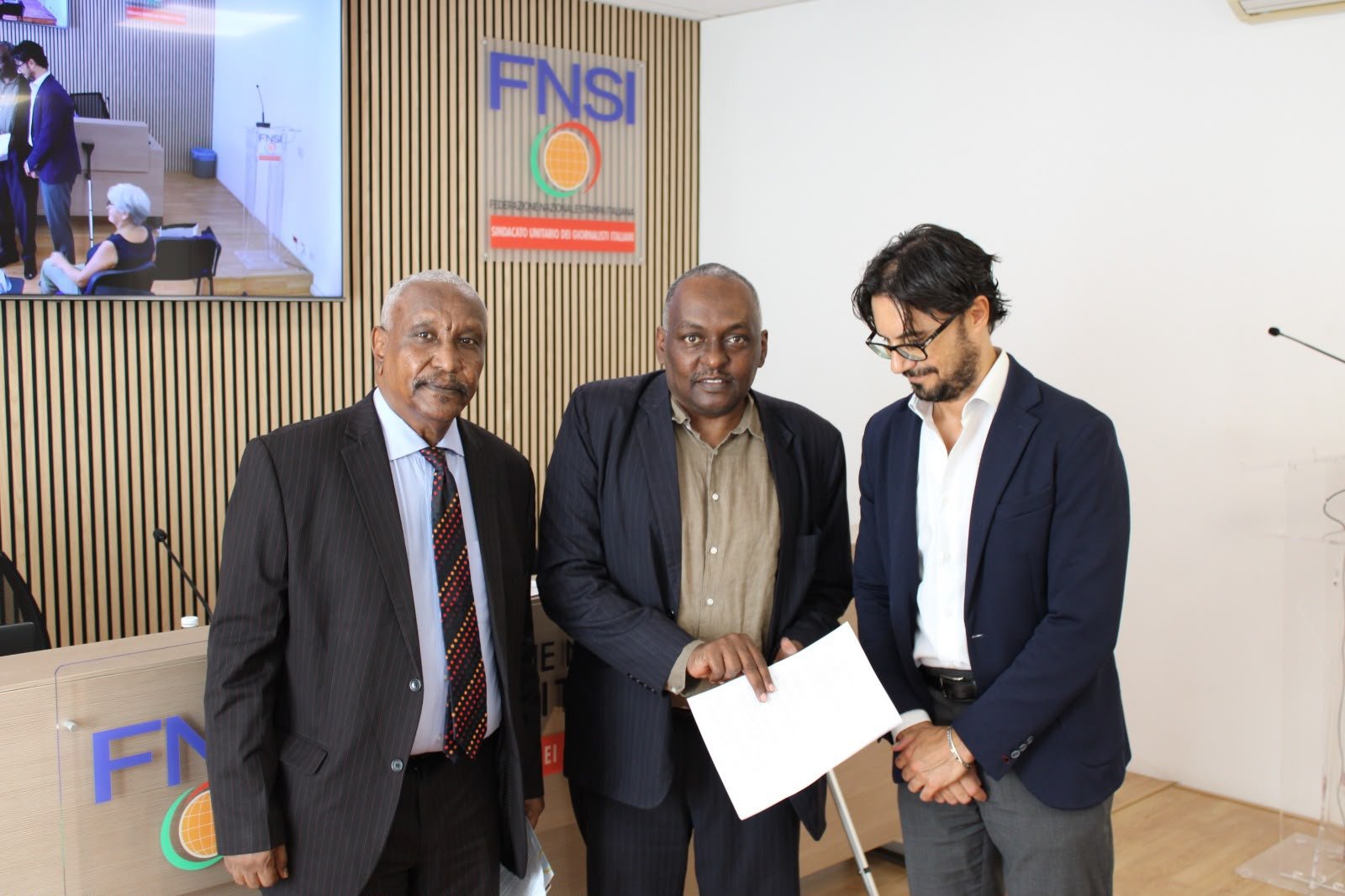
Yasir Arman, Chairman of the Sudan People’s Liberation Movement – Revolutionary Democratic Current (SPLM-RDC) and a prominent leader of the Anti-War Front, presented a package of key messages on the Sudanese crisis on Wednesday afternoon, September 16, 2026, from the headquarters of the National Federation of the Italian Press (FNSI) in Rome.
The messages were delivered during an official event at the FNSI headquarters, the organization representing professional journalists in Italy founded in 1908. The messages were handed to the Secretary General of the Federation, and the event was broadcast live to the Italian public in both Italian and English, in the presence of his colleague Dr. Mohamed Salih Yassin, in charge of Foreign Relations and Human Rights.
These Key messages were delivered this afternoon Wednesday the 16th of September 2026 at the Italian National Press Federation (FNSI), which represents the professional journalists in Italy established in 1908. And it was handed over to the secretary general of the Italian National Press Federation. It was live-streamed to the Italian audience in Italian and English Language.
We, in the anti-war movement in Sudan, value the important role of Italy, its people and government, in the efforts to bring peace and democracy in Sudan and to its people.
The current war in Sudan, is not limited to Sudan itself, it has geopolitical impact and consequences, as Sudan is part of the Red Sea, the Horn of Africa and the Sahel regions, and proximate to the Mediterranean and their impact when it comes to African, the Arab region, Europe and the entire world.
More importantly the war has affected the lives of more than 25 million people, among them 11 million are internally displaced persons IDPs, as reported in the statistics of the United Nations and major cities and strategic infrastructures and vast regions are producing agricultural products and livestock has been seriously affected and that Sudan is facing imminent famine today, without serious attention from the region and the international community, as we speak now, the Word Food Program WFP, has received only half of its budget to address the urgent needs for food and nutrition in Sudan. The catastrophic humanitarian situation in Sudan is bigger than the situation of Gaza and Ukraine combined together. It is not only a matter of numbers, but real tragedies and sufferings.
Around 5 million Sudanese are refugees in the neighboring countries as a result of the current ongoing war in Sudan, if they do not have the right to stay in their own Sudan, most of them will seek migration especially to Europe, given its proximity.
The war in Sudan should not be looked into as a war between generals and militias, more significantly, there is the anti-war movement and the pro-democracy forces, above all the forces of December Revolution, who constitute the vast majority in Sudan, and continue seeking peace, democracy and regional-international stability.
Through this war, the forces of political Islam, who had major take in Terrorism, internally and externally are returning back to power in Sudan, which endanger the peace and stability in Sudan, the regions and the wider international peace and security worldwide.
Sudan is a diverse country, the return of political Islam into power will infringe on the rights of equal citizenship, especially on religious freedom, particularly in the rights of Christians in Sudan.
We call for credible dialogue between the warring parties and the anti-war movement to reach an urgent humanitarian ceasefire and a settlement that will address the root cause of the conflict and establish a civilian democratic transition.
We call on the Holy Sea, the Italian political forces, civil society and the government to contribute effectively in realizing peace, democracy and stability in Sudan, and above all addressing the humanitarian disaster in Sudan.
We came here with my colleague Dr. Mohamed Salih YASSIN who is entrusted of our external relations and human rights file, after our participation in the regular 63rd session of the United Nations Human Rights Council in Geneva, and to meet with different institutions, friends in Italy and to strengthen the calls for peace and democracy in Sudan.
The so-called Khartoum National Dialogue, is a dialogue that is organized by one party to the conflict, and in the absence of credible process, humanitarian ceasefire and a conducive environment.
Lastly, our major take on the 63rd session of the United Nations Human Rights Council, is that the issue of the immediate humanitarian ceasefire fire has not been given the due attention it deserves, and the civilian agenda is gradually marginalized in the interest of the state legitimacy, and that would prolong the war.