
By Hollie McKay
Three years into the world’s worst humanitarian catastrophe, Sudan’s war has a body count approaching 400,000 dead and nearly 14 million displaced, a number that surpasses every other displacement crisis on earth. Two-thirds of the population, some 33.7 million people, are projected to need humanitarian assistance in 2026 alone.
Nonetheless, the Gulf states most positioned to end this war — Qatar and Saudi Arabia, in particular — are perhaps doing more to sustain it than to stop it.
The web of external interference in Sudan is well-documented at this point, if insufficiently condemned. Regional powers have been scrutinized, with UN sanctions monitors, Congressional Research Service analysts, and advocacy organizations amassing evidence highlighting the flow of weapons and drones escalating the conflict across multiple frontlines.
The involvement of Qatar, however, which has fashioned itself as a neutral mediator across every major regional conflict from Gaza to Libya, deserves harder scrutiny than it has received.
Doha has been hosting former Islamist members of the Bashir regime, figures described by the European Council on Foreign Relations as “crucial to providing the financial networks, weapons and military equipment needed for the SAF’s war effort.” In March 2025, the leader of the Islamist militia Al-Baraa ibn Malik — a 20,000-strong force fighting alongside Sudan’s Sudanese Armed Forces, now designated a terrorist organization by Washington as of March 2026, publicly stood before the Qatari embassy in Khartoum to thank Doha for its backing.
Moreover, Qatar’s foreign ministry has offered statements condemning RSF and calling for peace. Those statements and the Islamist militia commander’s public gratitude cannot both be taken at face value.
The Middle East Forum has reported an alleged Qatari arms airdrop to SAF forces in October 2025 — an operation Qatar has not confirmed or denied. Like much of what happens in Sudan, the allegation exists in the murk of a war the world has largely stopped watching. What is perhaps not in dispute is that Qatar’s alignment with Islamist networks in Sudan is ideologically coherent and strategically deliberate. It is the same calculus that drove Qatari support for the Muslim Brotherhood across the Arab Spring a decade ago, now playing out in a country drowning in famine.
When Saudi Arabia and Washington stood up the Jeddah process in May 2023, both warring sides actually signed — a feat no mediator has repeated since. The agreement was dead by the following morning. What came after, Geneva, Manama, and London’s second anniversary gathering, produced nothing that slowed the fighting by a single day.
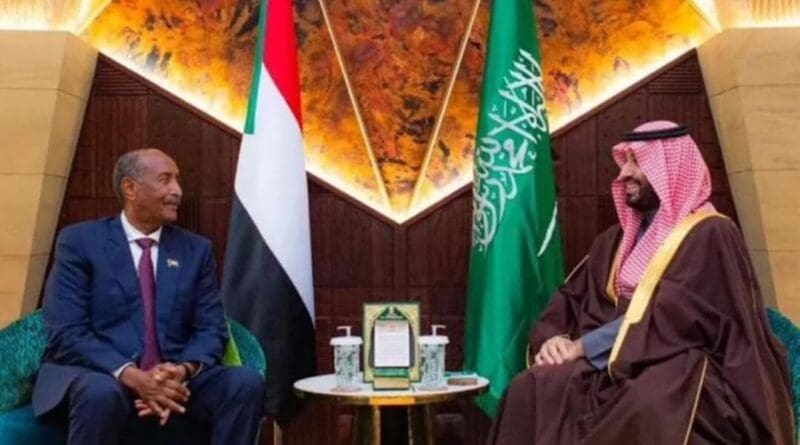
In the interim, Saudi Arabia has moved from reluctant mediator to open backer of SAF commander General Abdel Fattah al-Burhan. Crown Prince Mohammed bin Salman received al-Burhan at the Mecca royal palace in March 2025, and the two sides agreed to form a joint coordination council. By April 2026, MBS was hosting Burhan in Jeddah again amid reports that Riyadh had intervened to stall a $1.5 billion arms deal between Pakistan and Sudan — not to restrain the SAF, but apparently to keep that pipeline under Saudi influence.
The contradiction at the heart of Saudi policy is that Riyadh claims to oppose Islamism while propping up a military whose most effective fighting units are Islamist militias.
Washington designated Sudan’s Muslim Brotherhood a Specially Designated Global Terrorist entity. It pushed to formalize it as a Foreign Terrorist Organization from March 2026 onward, language that implicates the very command structures of the army Riyadh is backing. Saudi Arabia and Egypt have both pushed Burhan to rein in the Islamists. He issued a decree last year asserting all militias must operate under direct military command. It changed little on the ground, and few who watched it believed it was meant to. He performs the ask, a decree here, a statement there, while remaining entirely dependent on them to hold the front lines. Riyadh knows it. Burhan knows it. The arrangement continues anyway.
Saudi Arabia co-signed a Quad statement last September — alongside Washington, Cairo, and Abu Dhabi — pushing for a three-month ceasefire and transition talks. Al-Burhan turned it down the next day, and Riyadh said nothing. That silence is its own answer.
Qatar, meanwhile, has sheltered Islamist figures from the Bashir era whose networks have remained central to the SAF’s resupply, even as Doha issues statements calling for peace. Saudi Arabia has provided political and financial support to al-Burhan while co-hosting talks that have not yielded a single durable ceasefire. Estimates put the death toll somewhere between 150,000 and 400,000.
The range itself tells the story: a war this size, this long, watched this loosely. The people dying in it were never part of anyone’s diplomatic calculus.