
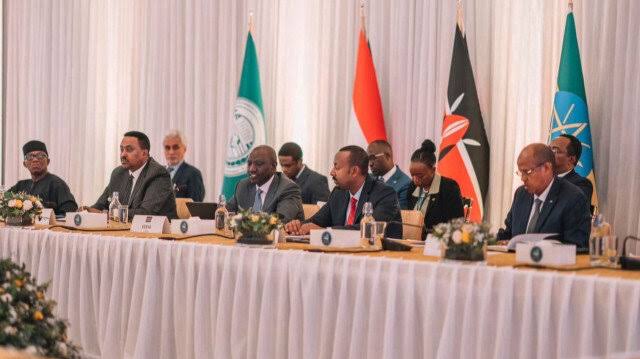
Nairobi | Kambal Abdelwahid Kambal
At a time when the Horn of Africa is facing growing security and political challenges, and the Intergovernmental Authority on Development (IGAD) is taking a leading role in mediation efforts across several regional crises, the organization is facing an internal controversy following the circulation of a document attributed to a whistleblower containing a series of allegations related to mismanagement, financial irregularities, and weaknesses in governance structures within the IGAD Secretariat.
These developments come during the tenure of Dr. Workneh Gebeyehu, who has served as IGAD’s Executive Secretary since 2019 — a period marked by an expansion of the organization’s regional responsibilities, alongside increasing political and security crises in the Horn of Africa, particularly conflicts in Sudan and Somalia and broader regional tensions.
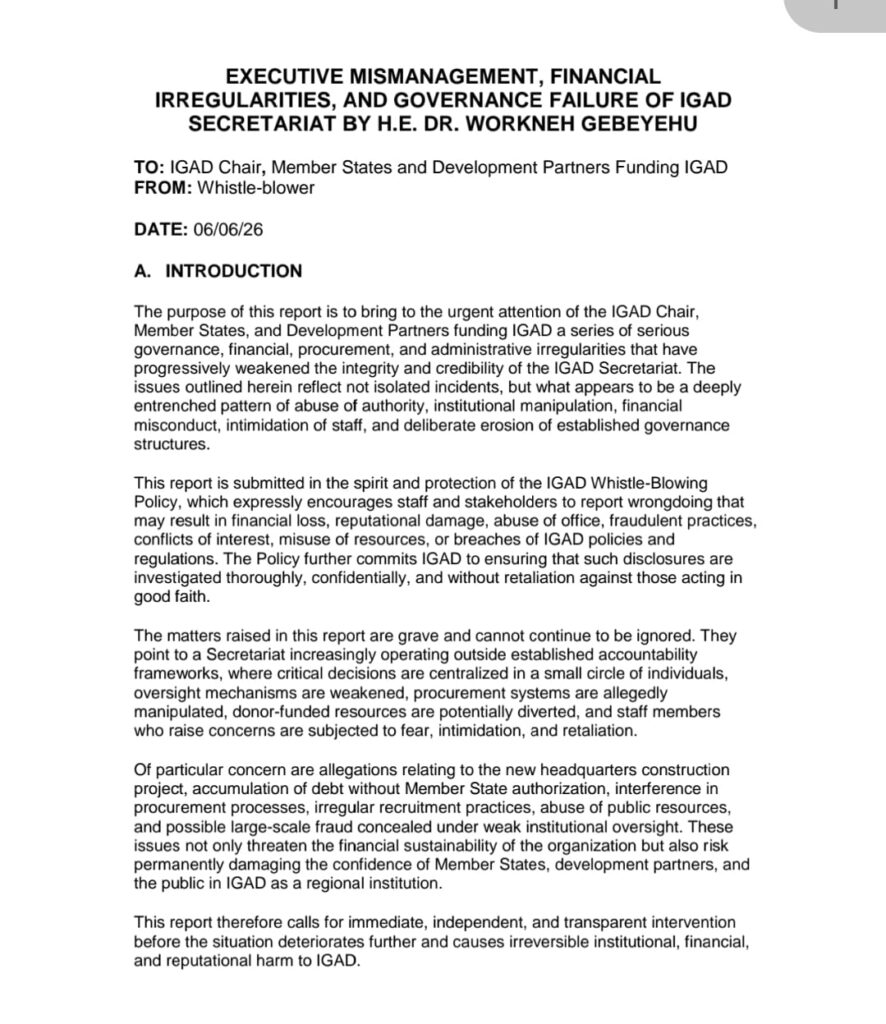
The whistleblower document directly raises allegations against IGAD’s executive administration, linking a number of the claims contained in the document to the management of governance issues, financial resources, and contractual processes within the Secretariat during the current leadership period.
However, as of the preparation of this report, these allegations remain unverified claims that have not been established through an independent publicly disclosed investigation. The inclusion of names of individuals or entities in a whistleblower document does not, in itself, constitute proof of legal or administrative responsibility unless confirmed through an official and transparent investigative process.
Dated 6 June 2026, the document calls on IGAD’s leadership, member states, and development partners to intervene and conduct an independent review, warning that continued institutional weaknesses — if proven — could undermine the organization’s credibility and its regional role.
IGAD… A Regional Organization at the Heart of Horn of Africa Crises
The Intergovernmental Authority on Development (IGAD) is one of Africa’s most prominent regional organizations. Its membership consists of eight countries: Djibouti, Ethiopia, Kenya, Somalia, Sudan, South Sudan, Uganda, and Eritrea, while its headquarters are located in Djibouti.
The organization was established in 1986 under the name Intergovernmental Authority on Drought and Development (IGADD), with the aim of coordinating regional efforts to address the impact of drought, famine, and desertification affecting the Horn of Africa.
In 1996, it was restructured under its current name, the Intergovernmental Authority on Development (IGAD), with an expanded mandate covering peace and security, conflict mediation, economic integration, sustainable development, humanitarian crises, migration, and climate change.
Over the past decades, IGAD has played a central role in addressing some of the region’s most complex challenges, including peace negotiations in Sudan and South Sudan, supporting stability efforts in Somalia, participating in regional security initiatives and counterterrorism efforts, as well as addressing food security and shared resource management.
However, the expansion of these responsibilities places a greater obligation on the organization to uphold the highest standards of governance, transparency, and accountability. The strength of regional institutions is not measured only by their ability to launch political initiatives, but also by the integrity of their internal systems, the independence of oversight mechanisms, and the effective management of resources.
From this perspective, the document at the center of this report carries significance not only because of the nature of the allegations it contains, but also because it raises broader questions about institutional reform within IGAD and the potential implications for its role in managing regional crises, particularly the Sudan conflict.
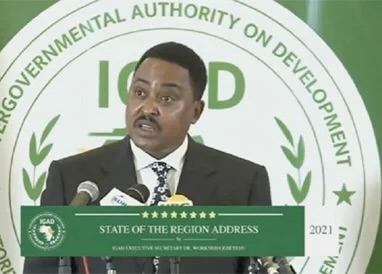
Allegations Targeting Key Areas of Administration
According to the whistleblower document, the alleged irregularities do not represent isolated administrative issues, but rather point to what the document describes as a pattern of governance and financial management failures within the IGAD Secretariat.
The document places the construction of IGAD’s new headquarters among the main issues requiring review, citing spending exceeding USD 17 million, alongside allegations of weak institutional oversight and insufficient transparency during certain stages of implementation.
The document calls for an independent financial and forensic audit of the project to determine whether procedures followed were compliant with approved financial and administrative regulations.
It also contains allegations regarding financial obligations and bank loans, which it claims were undertaken without clear authorization from member states. If proven, such allegations could raise questions regarding the limits of executive authority and oversight mechanisms governing strategic financial decisions within the organization.
Funding and Procurement… Conflict of Interest Allegations and Oversight Questions
The document also raises allegations concerning the management of financial resources allocated to certain programs and projects funded by development partners. It claims that some funds may have been redirected or used for purposes other than those for which they were originally allocated.
If these allegations are proven through an independent investigation, they could raise questions regarding compliance with external funding regulations and the effectiveness of internal financial control systems — issues that represent a cornerstone of the relationship between regional institutions and international donors.
The document further addresses procurement processes and tender procedures, alleging interference in certain stages of contracting, including the formation of technical committees and evaluation mechanisms. According to the document, such practices could affect the principles of transparency, fairness, and competitive bidding in procurement processes.
In this context, the document refers to what it describes as contractual relationships with subcontractors operating in the fields of communications and public relations. It alleges the existence of a company registered under the name of the son of IGAD’s Executive Secretary and claims that the company has been involved in activities related to the organization.
The document argues that, if verified, such a relationship could raise concerns regarding potential conflicts of interest and compliance with disclosure and transparency requirements in contractual arrangements, particularly within a regional institution whose credibility depends heavily on the confidence of member states and development partners in the integrity of its procedures.
The document links this issue to the need for a comprehensive review of procurement and contracting policies to ensure the independence of administrative and financial decisions and to prevent any direct or indirect influence that could undermine equal opportunities or institutional integrity.
As of the preparation of this report, no independent investigation findings or official decisions have been released confirming these allegations. The appearance of any individual or entity in a whistleblower document does not, by itself, establish legal or administrative liability unless confirmed by competent authorities.
Human Resources and Workplace Environment… Allegations over Appointments and Internal Oversight
Regarding human resources, the document raises allegations concerning recruitment and promotion processes within the IGAD Secretariat. It claims that some administrative decisions were not sufficiently based on professional qualifications and experience, but were instead influenced — according to the document — by personal considerations.
The document argues that such practices, if proven, could negatively affect institutional morale and weaken employees’ confidence in the fairness of administrative procedures.
It also refers to delays in the payment of employee salaries and entitlements, concerns regarding the management of staff benefit funds, and what it describes as the absence of an independent audit committee with clear authority to regularly review financial and administrative performance.
The document further alleges the existence of a working environment in which some employees may hesitate to report misconduct due to fears of pressure or retaliation, which it considers a factor limiting the effectiveness of internal accountability mechanisms.
Based on these claims, the document calls for the establishment of independent mechanisms to protect whistleblowers, strengthen internal reporting channels, and ensure that complaints are handled through professional and transparent procedures.
A Governance Crisis or a Leadership Crisis?
If future independent investigations establish the validity of the allegations contained in the document, the consequences could extend beyond individual accountability and raise broader questions regarding governance structures within IGAD, including internal oversight, resource management, and decision-making processes.
Regional organizations derive a significant part of their legitimacy from their ability to uphold the principles they advocate, particularly transparency, accountability, and adherence to institutional regulations.
From this perspective, any concerns regarding internal management practices could affect the level of confidence placed in the organization by member states, development partners, and international donors.
At the same time, an independent and transparent investigation could provide an opportunity to strengthen institutional credibility, whether the allegations are confirmed or dismissed, as strong institutions are also measured by their ability to review their own systems and address potential weaknesses.
The document argues that addressing the issue should not be limited to holding individuals accountable, but should instead involve a comprehensive review of governance structures, including strengthening the independence of audit bodies, updating procurement policies, and ensuring that recruitment and promotion decisions are based on clear professional criteria.
Potential Implications for IGAD’s Regional Role… and the Sudan File
These developments come at a critical time for the Horn of Africa, a region facing interconnected security and political challenges, while IGAD continues to play roles that extend beyond regional coordination to include political mediation, peace efforts, and responses to humanitarian crises — particularly the ongoing war in Sudan.
Since the outbreak of the conflict in Sudan in April 2023, IGAD has sought to play a role in facilitating dialogue between the Sudanese parties. However, its efforts have faced varying positions among some member states, as well as objections from Sudanese authorities in Port Sudan regarding some of the initiatives proposed by the organization during different stages of the crisis.
In recent months, relations between IGAD and the Sudanese authorities have witnessed a degree of political openness compared with previous periods of tension, amid a mutual recognition of the importance of regional engagement in addressing the security and humanitarian consequences of the war and its impact on neighboring countries.
In this context, observers believe that any controversy related to governance within IGAD could affect the organization’s image and the confidence of regional and international stakeholders. The effectiveness of a mediator depends not only on its political mandate, but also on the credibility of its institutions, the transparency of its administration, and the independence of its internal decision-making mechanisms.
Any decline in the confidence of member states or development partners could also affect the organization’s ability to mobilize the political and financial support required to implement its initiatives, particularly in complex situations that require broad coordination between governments, international organizations, and donors.
With regard to Sudan, there is currently no publicly available evidence confirming that these allegations have directly affected IGAD’s positions or its engagement with the parties to the conflict. However, continued controversy over governance within the organization could represent an additional challenge to its efforts to maintain its role as a regional platform for dialogue and mediation.
More broadly, the stability of regional institutions is a fundamental factor in the success of peace processes, as conflicting parties and international partners view institutional independence, neutrality, and administrative transparency as key elements influencing the credibility of initiatives they support.
Accordingly, any steps taken by IGAD to enhance transparency, review governance mechanisms, and respond to concerns raised in the document through an independent and publicly disclosed investigation could contribute to strengthening confidence in its institutions, regardless of the final outcome of such an inquiry.
Corruption and Governance Challenges in African Institutions
The implications raised by the circulated document extend beyond IGAD itself, reflecting a broader discussion about governance within African regional institutions at a time when these organizations are assuming increasingly important roles in conflict management, economic integration, and responses to humanitarian and security crises.
In recent years, regional organizations have become key partners for the African Union, the United Nations, and development partners in managing complex issues, including political mediation, monitoring peace agreements, humanitarian responses, and addressing cross-border security challenges.
As these responsibilities expand, expectations regarding transparency, accountability, and sound institutional management have also increased, given that effective internal governance is fundamental to the ability of these organizations to perform their external roles.
Governance experts argue that the effectiveness of any regional organization is not measured solely by the number of initiatives it launches or agreements it facilitates, but also by its ability to establish independent oversight systems, manage resources efficiently, and ensure accountability at all administrative levels.
In this context, the whistleblower document — regardless of the outcome of any future investigations — highlights the importance of having clear institutional mechanisms for receiving complaints, protecting whistleblowers, independently investigating allegations, and publishing findings transparently.
These principles are particularly significant for IGAD, given its central role in the Horn of Africa, where armed conflicts intersect with humanitarian crises, economic challenges, and security threats.
Conclusion
As of the preparation of this report, the allegations contained in the document remain subject to independent verification to determine their accuracy. Therefore, they must be treated as unproven claims, while respecting the right of all concerned parties to respond and provide relevant information.
Nevertheless, the fact that such questions have emerged within one of Africa’s most influential regional organizations highlights the importance of good governance as a cornerstone for building institutions capable of addressing regional crises.
Transparency, accountability, and the independence of oversight bodies are not merely administrative principles; they are essential elements in maintaining trust between an organization, its member states, development partners, and the wider public.
Regardless of the eventual outcome of this matter, it underscores that regional institutions with significant political and security responsibilities are increasingly required to uphold the highest standards of integrity and institutional oversight, because their credibility in managing conflicts begins with their ability to manage their own internal affairs according to principles of good governance.
For IGAD, this period could represent an opportunity to reassess governance structures and strengthen accountability and transparency mechanisms, thereby reinforcing confidence in the organization and preserving its position as one of the most important regional institutions in the Horn of Africa, at a time when the region urgently needs strong institutions capable of supporting peace, stability, and development.