
Assessment by Zaelnoon Suliman – African Affairs Unit, Progress Center for Policies – London
Overview
On Saturday, 25 April 2026, the Republic of Mali experienced a series of highly coordinated armed attacks targeting sovereign and military sites in the capital Bamako and strategic cities in the north — the most serious security test the country has faced in years. This escalation reflects a qualitative shift in the capacity of armed groups to combine urban strikes with simultaneous field operations.
Key Facts
The attacks began at dawn, targeting the National Gendarmerie School in Falladié and the perimeter of Modibo Keïta International Airport, causing widespread confusion within the capital — particularly given the proximity of these targets to Kati Military Base, which represents the country’s military and political center of gravity.
Simultaneously, armed units launched coordinated attacks on barracks and monitoring posts belonging to the Malian army and the Russian “Africa Corps” across various areas of the Azawad region, indicating a high level of operational coordination. These operations coincided with intensified clashes in the north, widespread civilian anxiety in major cities, and partial displacement of civilians.
Military movements were recorded along the Mali-Mauritania border amid a state of high alert, with explosions heard in some villages, as armed groups announced their seizure of border crossings and strategic positions previously held by government forces.
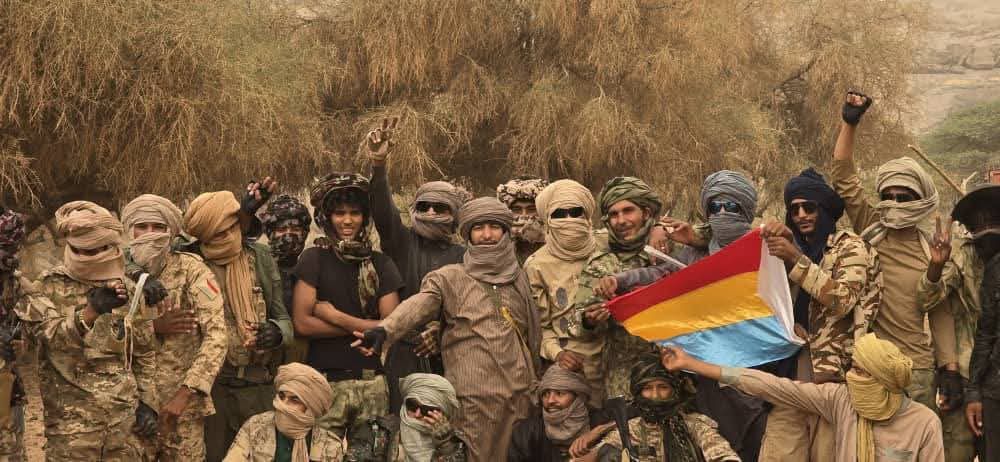
Jama’at Nusrat al-Islam wal-Muslimin (JNIM) claimed responsibility for the Bamako operations, confirming it had targeted the Presidential Palace, the Ministry of Defence, the capital’s airport, and military sites in Kati. The group also announced control over the city of Dounté, most military positions in Sévaré and Wago, and the city of Kidal — achieved in coordination with the Movement for the Liberation of Azawad and allied local forces.
The Malian Presidency, for its part, issued a brief statement acknowledging a foiled infiltration attempt at the Gendarmerie School in Falladié, asserting that the armed forces had repelled the attack and that vital sites in the capital were secured — while offering no details on the situation in the north.
Analysis
The security developments in Mali point toward one of the following scenarios: the government forces, with Russian support, succeed in restoring security and containing the political and psychological fallout; the military council exploits the attacks to pursue broader security partnerships — including re-engagement with the West — recognizing that the Russian partnership alone is insufficient to counter this level of threat; or the armed groups successfully convert these attacks into a prelude to larger operations, exploiting governmental confusion and intelligence gaps to expand their foothold around the capital and in border regions.
The developments reveal several qualitatively significant indicators:
First: The attacks demonstrate an advanced level of operational coordination — simultaneous strikes in Bamako and the north — reflecting the armed groups’ capacity to maneuver across multiple theatres.
Second: The acknowledged coordination with the Movement for the Liberation of Azawad points to the emergence of a field alliance combining jihadist actors with ethno-separatist forces, enhancing operational effectiveness and expanding geographical reach.
Third: The offer to neutralize the Russian presence in exchange for halting attacks against it reflects a pragmatic posture that transcends conventional ideology, suggesting an attempt to reorder conflict priorities in ways that consolidate territorial gains.
Fourth: The armed groups’ ability to strike targets inside Bamako places the official narrative under mounting pressure, pointing to potential security breaches and vulnerabilities in the protection architecture — particularly given the simultaneous escalation in the north.
Conclusions
The coordinated attacks indicate that Mali’s armed groups have transitioned to a more advanced phase of planning and execution, expanding operations geographically while strengthening alliance networks. Against this backdrop, the government’s response appears limited in its capacity to contain the political and security impact — reflecting a widening gap between the threats on the ground and the state’s ability to address them.
This escalation will in all likelihood compel a comprehensive reassessment of security and defence approaches, as pressure mounts across multiple fronts and armed groups demonstrate a growing capacity for operational initiative.
The attacks of Saturday, 25 April 2026 have confirmed that Mali has moved beyond the stage of a threat confined to the periphery — it has entered the stage of a threat knocking at the capital’s door. This raises serious questions about the Malian state’s capacity to defend its political and military center of gravity on multiple simultaneous fronts.
The terrorist operations affirm the value of political engagement with the root causes of the crisis, and demonstrate the failure of a purely security-driven strategy in the absence of genuine governance reform that dries up recruitment pipelines and convinces marginalized communities that the state is capable of earning their trust.
Should the Malian government fail to reassert security and political control, Mali may find itself confronting a scenario resembling Syria’s trajectory — one in which armed groups breach Bamako and the major cities, topple the military government, and replace it with an Islamist leadership. Such a transformation would carry consequences far beyond Mali’s borders, casting a long shadow over the political and security landscape across West Africa.